Success Story · Experimental Validation

How do you reduce gender gaps in self-assessment and confidence about the future?

We measured the effect of three interventions to bring women's and men's self-ratings closer to their actual performance.

Client
Comfama · Colombia
Services
Behavioral Design · Experimental Validation
Method
Experiment with real users
Sector
Family compensation fund
The challenge

Women rated themselves below their actual performance

Note: in Colombia, a "caja de compensación familiar" (family compensation fund) is a private entity that provides workers and their families with benefits such as subsidies, healthcare, education, and cultural services.

Comfama, one of Colombia's largest family compensation funds, faced underrepresentation of women in leadership positions.

Among the causes, we identified differences in how women and men self-assess their performance: women tend to rate themselves below their actual performance, and men above it. Addressing the underrepresentation required changing the perceptions and implicit barriers behind that gap.

The goal was to bring men's and women's self-ratings in line with their actual performance.

What we did

An experiment with three treatments

We designed an experiment with real users that showed different messages between a test and the self-assessment of performance on that test. We measured the effect of each treatment on self-ratings and confidence about the future.

1

Control group

No message. We measured the gap between actual performance and self-assessment as a baseline for comparison.

2

Quantitative feedback

Concrete information about actual performance on the test.

3

Information about gender bias

A message about the gender biases present in self-assessments.

4

Feedback + bias information

Quantitative performance feedback plus the message about gender bias in self-assessments.

Results

What moved the needle

All interventions narrowed the gap between participants' self-assessments and their actual performance.
Quantitative performance feedback was the intervention that brought self-ratings closest to actual performance.
Informing participants about bias without quantitative feedback lowered their confidence about the future.

Figure · Actual performance vs. self-assessment by treatment
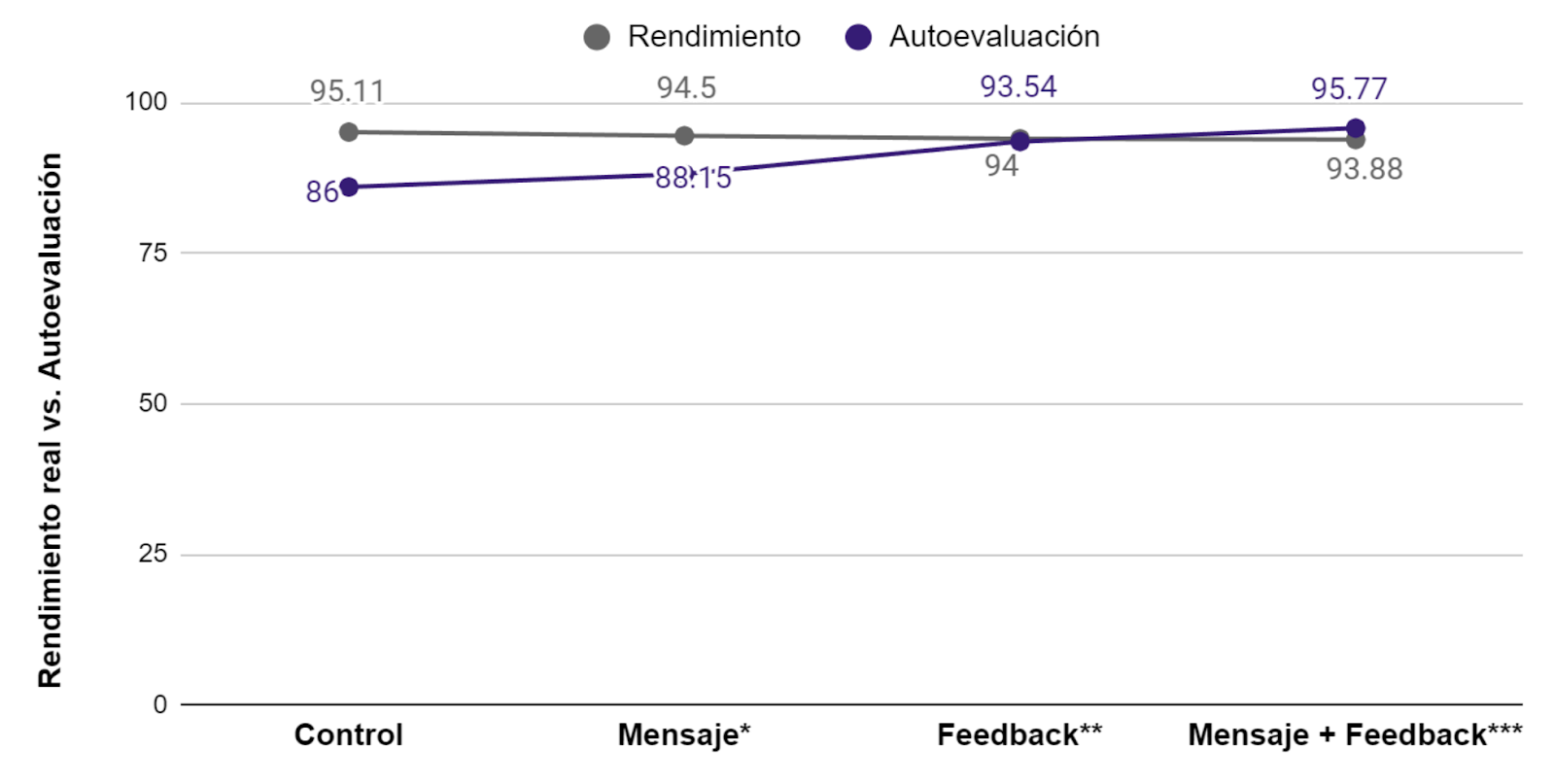
Line chart: self-assessment starts at 86 and moves closer to actual performance (around 95) as message and feedback are added, reaching 95.77 with Message + Feedback.
The insight

Giving people concrete performance data works better than warning about bias in the abstract. Pointing out the bias on its own, without evidence of actual performance, can backfire on confidence. It's a direct application of the framing effect: how feedback is presented changes its effect, not just its content.

For decision-makers

Lessons for designing solutions

Interventions grounded in behavioral science are key to improving self-assessments and strengthening confidence about one's professional future.

They make it possible to address and shift perceptions and behaviors effectively, driving real progress on critical issues such as gender equity in the workplace. Solving major institutional challenges, like the underrepresentation of women in leadership positions, requires many small changes across the entire career path.

Implementing these strategies from a deep understanding of human behavior can lead to further transformations in organizational culture and practices.

Have a behavioral challenge to measure?

Let's design the experiment that gives you certainty before you decide.